Magic, places & world knowledge
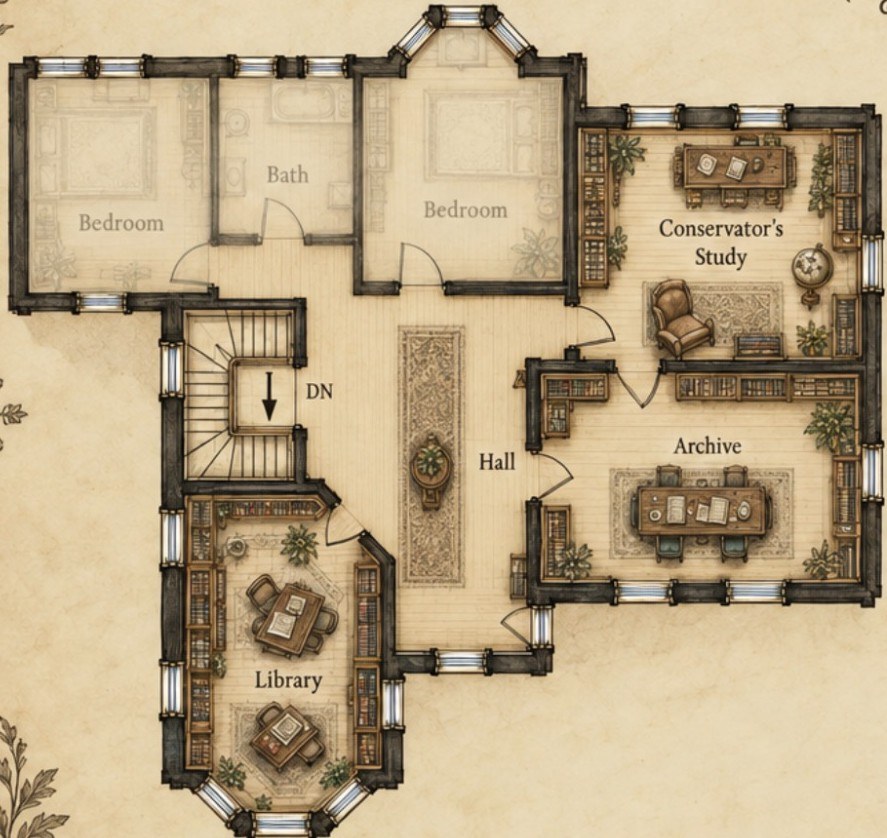
The Library
Reference notes on magic, places, and the connections between the Conservatory’s Artifacts.
Choose a volume to explore
← Back to House DirectoryCelestial Relics
Celestial Relics
Objects transformed beneath extraordinary skies
Caught in a celestial event
A bottle, a sugar bowl, or another familiar object may become a Celestial Artifact when it is caught within a celestial Ether event. The object already exists; the event leaves it permanently transformed.
Rituals and rites may encourage these events, as may solstices, eclipses, and other celestial circumstances. The object’s former purpose does not determine its place in the collection. What matters is its encounter with celestial Ether.
The transformation may leave stars, moons, crystals, or celestially born flora across the surface. These are characteristic traces of celestial influence, sometimes covering much of the original object.
The Void Dragon Mug
The Void Dragon Mug’s record associates its origin with rare celestial alignments and moonlit ceremonies. Its star-covered surface reflects those circumstances: a familiar vessel carrying the marks of an extraordinary transformation.
The brief account also raises the question of a Void Dragon’s presence, but does not explain how it came to be associated with the Artifact.
Echobound Relics
Echobound Relics
Where stories leave their mark
The persistence of a story
A story may outlive the voice that first told it. Passed through generations, it becomes part of a place: remembered in its customs, repeated in its tales, and sustained by belief. Where that influence endures, it may leave an impression upon the surrounding Ether.
The Echobound Relics collection brings together Artifacts born of this accumulated influence. Their origins lie in folklore, oral tradition, and shared memory. Each remains a unique expression of the place and legend from which it arose.
The Enchanted Orchard Chalice
The Enchanted Orchard Chalice is associated with the Slavic legend of the Firebird and the ancient orchard where golden fruit was said to grow. Its record places it within the Echobound collection.
The orchard gives the Chalice a particular connection to the wider legend. Generations of storytelling and belief are the influence through which such a remembered place may impress itself upon Ether.
The precise circumstances of the Chalice’s formation are not recorded. What its account offers is a connection between a particular Artifact, a remembered setting, and an enduring tradition. It suggests that a legend may leave behind more than a story.
Stormkin Relics
Stormkin Relics
When a passing moment takes form
When the atmosphere gathers Ether
Stormkin Artifacts are born when natural conditions and atmospheric Ether gather with enough force to reach a breaking point. Ether then takes physical form in a sudden, sometimes violent, burst.
The name encompasses more than thunderstorms. First frost, gathering summer clouds, and seasonal transitions can also contribute to Stormkin formation. What unites the collection is this manner of birth, rather than any single kind of weather.
An Artifact may therefore carry the character of a tempest or of a quieter seasonal occasion. The Harvest Moon and Lavender Anvil-Glow Vessels show something of that range.
The Harvest Moon Vessel
The Harvest Moon Vessel’s account brings together changing leaves, the scents and sounds of autumn, crisp air, harvest moonlight, and the joy of people dancing beneath it.
These influences contributed to a build-up of atmospheric Ether. The moon belongs to the account, but so do the season and the celebration. Together, they explain why the Vessel is classified among Stormkin Relics rather than by its lunar association alone.
Here, the collection preserves the character of an autumnal occasion rather than the force of a thunderstorm.
The Lavender Anvil-Glow Vessel
The Lavender Anvil-Glow Vessel is associated with twilight and an approaching storm. Its pinks and purples recall the sky’s last light, while a jagged, shimmering geode evokes the crown of a towering storm cloud.
Its account centres on a powerful build-up of magical pressure taking physical form. Set beside the Harvest Moon Vessel, it shows how differently Stormkin origins can be expressed. One draws together the changing season and a gathering of people; the other, the intensity of a storm-lit sky.
Both belong to the study of atmospheric Ether at the moment it gives rise to an Artifact.
Tidekin Relics
Tidekin Relics
What the sea brings ashore
Born of the sea
A shoreline can tell us where an Artifact was discovered without revealing where it was born.
Tidekin Artifacts form where ocean tides concentrate Ether. The beings known as Tidekin can also focus Ether through their hoards, gathering objects around which this magical influence accumulates.
Shells, pearls, sea glass, coral, and crystalline marine formations are characteristic of the collection. Artifacts are most often recovered following a coastal Etheric Convergence—a gathering of Ether capable of producing an Artifact.
The Dawn Tide Vessel
The Dawn Tide Vessel was recovered at dawn on a quiet shoreline after a magical Convergence. Shells, pearls, sea glass, and crystalline formations lie in layers across its surface.
These layers suggest a prolonged association with Tidekin influence before the Vessel came ashore. Its recovery at dawn is recorded; the duration of that earlier association is not.
The Siren’s Hoard Elixir
The Siren’s Hoard Elixir was discovered on an island shore after a tropical storm that appears to have stirred a substantial Etheric Convergence. Growth and sparkling treasure densely encase its surface.
Its account suggests that the storm released an Artifact long held within Tidekin influence. This helps explain its place in the collection: weather may bring an Artifact ashore without being the influence responsible for its birth.
Wildling Relics
Wildling Relics
Where the Wild takes root
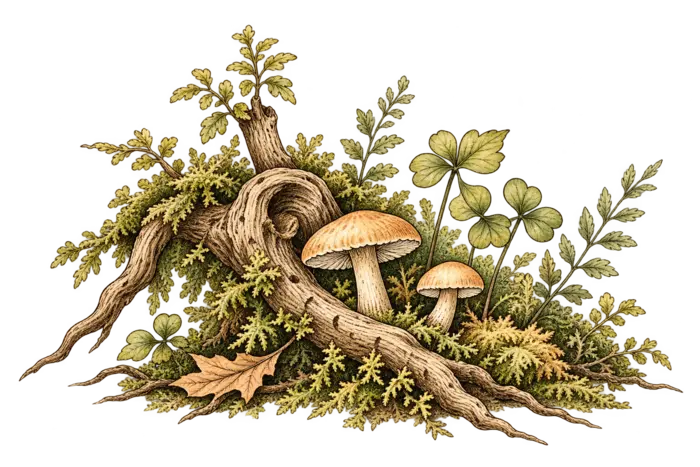
Within the Fey Wild, a vessel left among roots and moss may become so thoroughly claimed by its surroundings that the original form is difficult to distinguish beneath the growth.
A gradual transformation
Wildling Artifacts arise where dense natural Ether gathers among ancient trees, luminous mosses, alchemical flowers, and fungi. Their formation often appears gradual, with roots, vines, and blossoms becoming part of a familiar vessel over time.
Some are associated with Residual Ether—the Ether remaining after an earlier event. This may accumulate again and contribute to the birth of another Artifact. The Serpentleaf Vessel Set offers a recorded example of this quieter manner of formation.
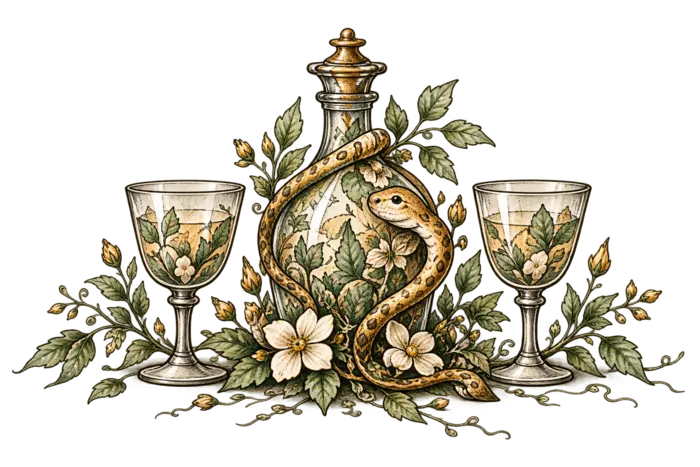
The Serpentleaf Vessel Set
The set comprises a bottle and two accompanying glasses bearing layers of richly coloured foliage. Its record suggests that lingering Ether entered the glass gradually, allowing the leaves to spread without entirely overtaking the vessels.
Several leaves glow faintly, as does the small snake companion discovered nestled among them. Whether the creature developed alongside the Artifact or simply found a comfortable place in the foliage remains uncertain.
The visible glass is part of the set’s character. The Wild has established itself without concealing the forms beneath it.
When growth takes hold
The Fey Touched Green Vessel presents a more extensive transformation. Fungi and climbing foliage cover a silver-plated sugar bowl so thoroughly that separating the original vessel from later growth is no longer practical. Its softly luminous fungi are particularly noted in the record.
Together, these Artifacts show the range of Wildling growth: from foliage that leaves much of the vessel visible to an almost complete covering. Both belong to the same collection, but each retains a distinct character.
Ether — Why It’s Magic
Ether — Why It’s Magic
On the nature and birth of Artifacts
The unseen beginning
Ether is the invisible magical medium present throughout the world. It gathers, moves, and responds to its surroundings. Under extraordinary conditions, its influence gives rise to an Artifact.
An Artifact may emerge through a gradual process or a sudden event. Some begin as existing objects. A bottle or sugar bowl caught in a celestial Ether event, for example, can be permanently transformed. In this case, the birth of the Artifact is the transformation, not the first existence of the object.
Gathering and taking form
The local concentration of Ether is called Etheric Density. A high concentration may indicate that an Artifact’s formation is approaching.
An Etheric Convergence is a gathering of Ether capable of producing an Artifact. Etheric Condensation is the moment Ether takes physical form. Gathering, formation, and eventual discovery are related, but they need not occur together.
Ether remaining after an event is known as Residual Ether. It can accumulate again and contribute to another formation. An earlier event may therefore remain important to the later history of a place.
What the collections describe
The Conservatory groups Artifacts into relic collections according to the influence responsible for their formation. An Etheric signature consists of the identifiable characteristics that help the Conservator classify an Artifact.
Appearance is considered alongside the recorded origin. Leaves, crystals, or moonlike forms may occur in more than one collection. The conditions of formation help explain their significance.
The Harvest Moon Vessel, for example, belongs to Stormkin because its account concerns atmospheric Ether gathering through an autumnal occasion. Its name identifies one part of that history, not the whole of it.
From discovery to keeping
After discovery, the Conservator documents the Artifact’s name, number, classification, photographic evidence, recorded origin, and observations. Together, these form its permanent record in the Archive.
The record preserves both what has been observed and what remains uncertain. It stays in the Archive when the Artifact is released to a Keeper, the person entrusted with its care.
The Artifact continues its journey. Its documented history remains available to those who come after.